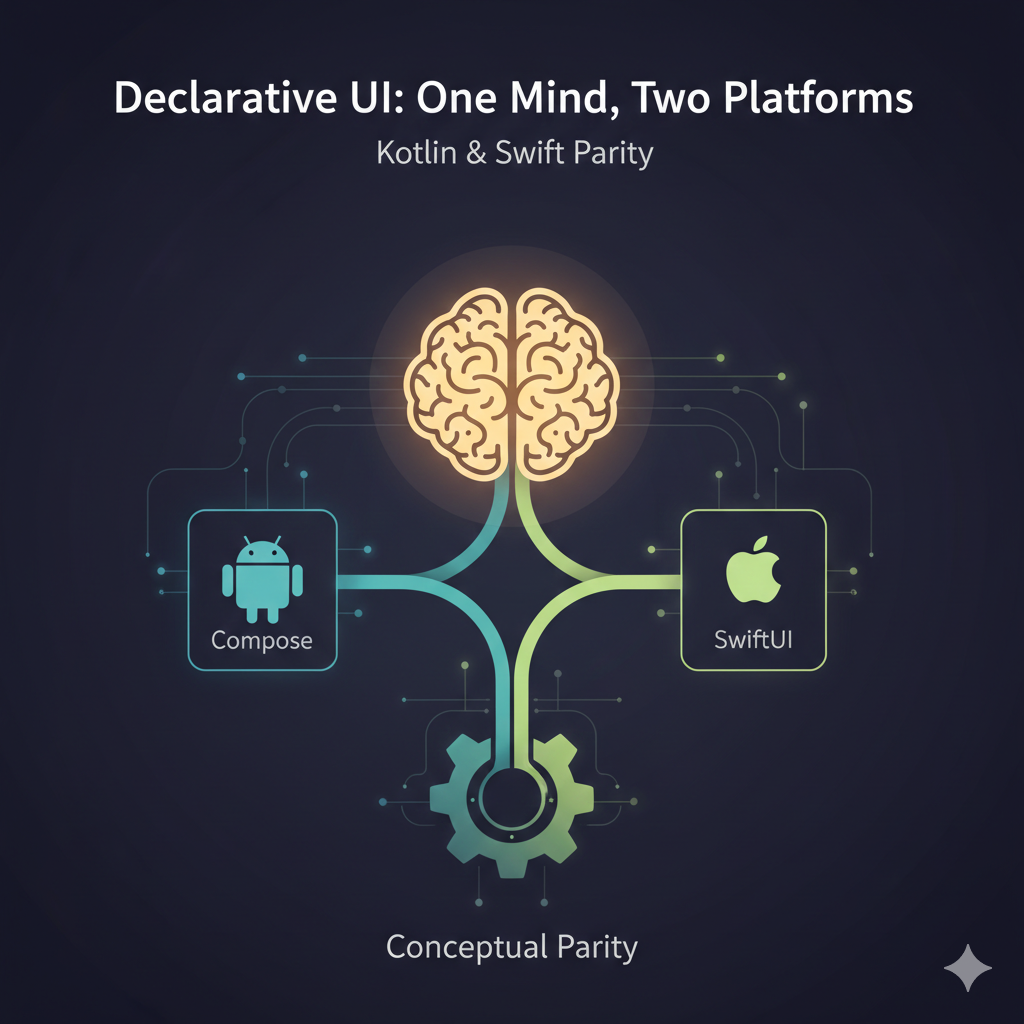
In the era of Declarative UI, the transition between Android (Kotlin) and iOS (Swift) is no longer a journey of starting from scratch. Once you master the "State-driven UI" mechanism, you realize that Jetpack Compose and SwiftUI share a profound architectural bond.
The real challenge in parallel development isn't the syntax—it's maintaining a Unified Mental Model. This article explores the internal mechanics and the conceptual parity that allows developers to mirror logic across platforms seamlessly.
1. Internal Architectures: Slot Table vs. Structural Diffing
Despite their declarative nature, the "brains" of these frameworks operate differently. Understanding these internals is key to optimizing performance, especially for data-heavy applications.
| Feature | Jetpack Compose (Android) | SwiftUI (iOS) |
| Core Mechanism | Slot Table: Flat array storage (Gap Buffer) to optimize memory. | Structural Diffing: Compares View structs using Reflection. |
| Update Strategy | Recomposition: Re-executes only the scopes affected by state changes. | Body Re-evaluation: Re-calculates the body property when attributes change. |
| Ecosystem | OS-Independent (Library-based updates). | OS-Integrated (Dependent on iOS version). |
Architectural Insight: Compose offers explicit control viarememberandMutableState. In contrast, SwiftUI abstracts complexity through Property Wrappers (@State, @Binding), requiring developers to be precise with data flow to prevent redundant renders.
2. The Conceptual Parity in UI Design
When building core flows like Authentication or User Profiles, I rely on Conceptual Parity—mapping equivalent components across platforms rather than rote memorization of syntax.
Component Mapping Table
| UI Concept | Jetpack Compose | SwiftUI |
| Vertical Stack | Column | VStack |
| Horizontal Stack | Row | HStack |
| Z-Axis Stack | Box | ZStack |
| Local State | remember { mutableStateOf() } | @State |
| State Hoisting | Lambda / Function | @Binding |
| Dependency Injection | CompositionLocal | @EnvironmentObject |
By leveraging this parity, a UI structure designed for Android can be mirrored to iOS almost instantly, as the underlying hierarchy remains consistent.
3. Synchronizing Lifecycle & Business Logic
To ensure stability across both ecosystems, decoupling business logic from the UI is mandatory.
- Preferred Pattern: MVVM (Model-View-ViewModel).
- Synchronization Strategy:
- Android:
ViewModel(Lifecycle-aware) withStateFlow. - iOS:
ObservableObject(or@Observable) with@Published.
- Android:
The Logic Porting Process
- Requirement Extraction: Identify processing rules from project documentation (Docx/PDF).
- Pseudo-coding: Draft the logic flow focusing on data streams rather than specific syntax.
- Parallel Implementation: Port the logic to both ViewModels. Due to the convergence of Kotlin and Swift, the handling of collections, strings, and conditions is remarkably similar.
- Async Management: Use
viewModelScope(Kotlin) and.task(Swift) to anchor API calls to the appropriate lifecycle, preventing memory leaks.
4. Performance Pitfalls in Parallel Dev
Even with high conceptual parity, platform-specific "gotchas" exist:
- SwiftUI (The Diffing Trap): Be cautious when passing complex objects or closures to subviews. If SwiftUI cannot diff efficiently, it may re-render the entire hierarchy, consuming excessive resources.
- Compose (The Recomposition Trap): Avoid expensive operations (e.g., data formatting) directly inside a Composable. Prioritize
rememberor offload the logic to the ViewModel.
5. Conclusion: Master One, Understand Both
Parallel development is not about doubling the workload; it’s about expanding architectural vision. When you understand the parity between these frameworks, you are no longer confined by a single language.
The Unified Thinking approach between Jetpack Compose and SwiftUI is the key to building high-quality, maintainable, and synchronized experiences for users on any platform.